Plumbing code compliance is defined as meeting the minimum installation and safety standards set by regulatory bodies like the International Code Council (ICC) and enforced through local building departments. Examples of plumbing code compliance issues range from improper drain venting and incorrect pipe slope to prohibited trap types and missing permits. Each violation creates real risks: sewer gas exposure, water contamination, structural damage, and costly forced demolition. Homeowners and commercial property managers who understand these violations before an inspection avoid fines, stop-work orders, and expensive corrections.
1. Common examples of plumbing code compliance issues with venting
Venting violations are among the most frequently cited plumbing regulation issues inspectors find. Every drain in a code-compliant system needs a vent to equalize air pressure and prevent sewer gas from entering the building. When venting fails, the consequences go beyond bad odors. Slow drains, gurgling sounds, and dry traps are all signs that sewer gases, including hydrogen sulfide and methane, are entering living spaces.
The most common venting violations include:
- Vents terminating in attics or crawl spaces instead of extending through the roof to open air
- Undersized vent pipes that cannot handle the fixture load connected to them
- S-traps used in place of P-traps, which cause sewer gas intrusion by siphoning the water seal dry
- Missing vents entirely on fixtures added during remodels without pulling a permit
- Vent pipes pitched incorrectly, causing condensation to pool and block airflow
Understanding how plumbing vents work is the first step toward catching these problems before an inspector does.
Pro Tip: If you smell sewer gas near a sink or floor drain, check whether the fixture has a proper P-trap and a connected vent before assuming the problem is a clog.
2. How incorrect drain pipe slope causes plumbing code failures
Drain pipe slope is one of the most measurable and most failed standards in residential and commercial plumbing. The standard slope requirement is 1/4 inch per foot for pipes 3 inches or smaller. That standard exists because gravity moves waste through the pipe, and the slope controls how fast.
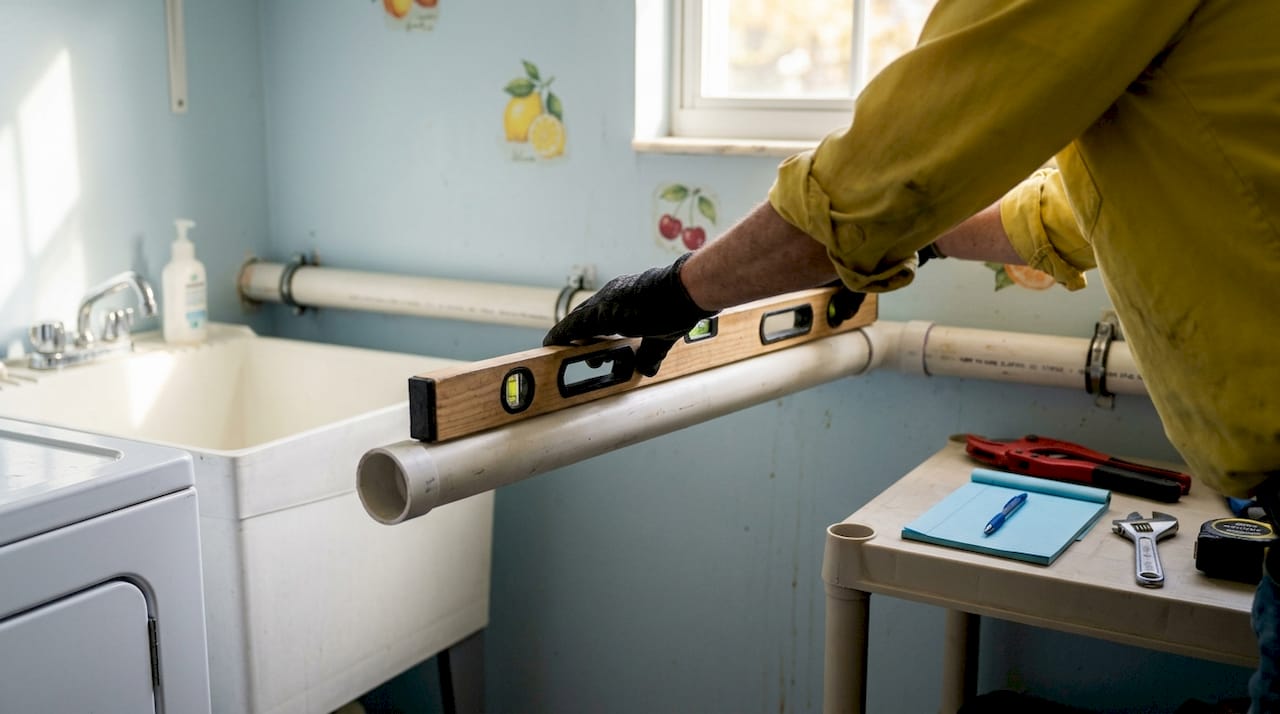
A slope that is too flat lets solids settle and build up, creating recurring clogs. A slope that is too steep is equally problematic. When water runs ahead of solids, the solids are left behind and accumulate in the pipe. Correct pipe slope prevents both of these failure modes by keeping water and solids moving together at the right speed.
Inspectors measure slope with a digital level or by checking the drop across a known pipe length. Common mistakes include:
- Eyeballing the slope instead of measuring it
- Allowing pipes to sag between supports, creating low spots
- Using too few hangers, which lets pipes shift over time
- Failing to account for slope when routing pipes around obstacles
Pro Tip: Use a 4-foot level and measure the drop at each end. For a 4-foot pipe run at 1/4 inch per foot, the low end should sit exactly 1 inch lower than the high end.
3. Which prohibited plumbing fittings commonly cause compliance problems
Certain fittings fail inspection every time, regardless of how they are installed. The most common offenders are S-traps, bell traps, and flexible accordion-style drain kits. Each one is widely available at hardware stores, which is exactly why they show up so often in non-compliant installations.
S-traps lose their water seal through self-siphoning. Once the seal is gone, sewer gas flows freely into the room. Bell traps, sometimes found in older floor drain installations, trap debris and are nearly impossible to clean without removal. Flexible accordion-style drain kits collect debris in their ridges and impede flow. Inspectors reject them routinely, even when they are sold as “universal” or “code-compliant” on the packaging.
Flexible accordion drain kits are sold in virtually every home improvement store, but they fail inspection without exception. The ridged interior traps grease, hair, and debris, creating blockages that rigid P-traps avoid entirely. Buying one saves a few dollars and costs a failed inspection.
Material compatibility is another source of violations. Connecting copper to galvanized steel without a dielectric union causes corrosion at the joint. Mixing ABS and PVC plastic pipe without an approved transition coupling is also a code failure. The fitting itself may look fine, but the chemical incompatibility degrades the joint over time.
4. What procedural compliance issues lead to plumbing code violations
Procedural violations are the category that surprises most property owners. The plumbing itself may be installed correctly, but if the paperwork is missing or the inspection was skipped, the work is still non-compliant. Unpermitted plumbing work often requires demolition to expose the pipes for verification, which costs far more than the original permit fee would have.
The permit process includes application, plan review, rough-in inspection, and final approval. Plan reviews take 2–15 business days depending on the jurisdiction. Most jurisdictions require 24–48 hours’ notice to schedule a rough-in inspection. Missing any of these steps creates a gap in the compliance record that surfaces during property sales, insurance claims, or future renovations.
Common procedural violations include:
- Skipping the permit entirely for work that clearly requires one, such as adding a bathroom or relocating a water heater
- Missing the rough-in inspection by covering walls before the inspector signs off
- Inaccessible cleanouts, which code requires to be reachable without removing permanent fixtures
- No shutoff valves at fixtures, making maintenance and emergency shutoffs impossible
- Missing nail plates on pipes within 1 1/4 inches of framing edges, which causes rough-in failures when inspectors find unprotected pipes
Understanding how plumbing inspection works before starting any project saves time and money at every stage.
Pro Tip: Take photos of all rough-in plumbing before closing walls. If a question arises during a future inspection or sale, you have documentation that the work was done correctly.
5. How water heater installations often violate plumbing codes
Water heater violations are not administrative oversights. These violations are safety hazards that can cause explosions, flooding, and carbon monoxide exposure. Inspectors treat them seriously, and so should every property owner.
The most common water heater code violations are:
- Missing expansion tank on closed-loop systems with a backflow preventer or pressure-reducing valve
- Improper T&P relief valve discharge routed upward, into a drain, or terminated too high above the floor
- No drip pan under the unit in locations where a leak would cause property damage
- Insufficient clearance from combustibles on gas-fired units
- No seismic strapping in jurisdictions that require it
Each of these violations has a direct safety consequence. An expansion tank absorbs pressure spikes that would otherwise stress the tank and connected pipes. A correctly routed T&P discharge line directs scalding water safely to the floor if the valve activates. Without a drip pan, a slow leak goes undetected until it causes structural damage. Commercial property managers overseeing multiple units should add water heater compliance to their commercial plumbing inspection checklist.
6. Cross connections and backflow: a critical safety violation
Cross connections between potable and non-potable water systems represent the most urgent category of plumbing standards violations. A cross connection without an approved backflow preventer creates an immediate health hazard and triggers emergency stop-work orders with no cure period. That means work stops immediately, not after a correction window.
Common cross connection examples include irrigation systems tied directly to the potable supply without a backflow preventer, hose bibs without vacuum breakers, and commercial dishwashers connected without an air gap. The risk is real: a pressure drop in the main supply line can pull contaminated water backward into the drinking water system. Backflow prevention devices, from simple vacuum breakers to reduced-pressure zone assemblies, are the code-required solution. Property managers should verify that every connection between the potable supply and any external or non-potable system has an approved, tested device in place.
Key Takeaways
Plumbing code compliance requires correct venting, proper pipe slope, approved fittings, complete permits, and safe water heater installation to protect health and avoid costly enforcement actions.
| Point | Details |
|---|---|
| Venting violations top the list | Missing or improperly terminated vents allow sewer gas into living spaces and cause slow drains. |
| Slope must be measured, not guessed | The standard is 1/4 inch per foot for pipes 3 inches or smaller; eyeballing causes clogs and failures. |
| Prohibited fittings always fail | S-traps, bell traps, and accordion drain kits are rejected at inspection regardless of retail availability. |
| Permits protect your investment | Unpermitted work requires demolition for verification, costing far more than the original permit fee. |
| Water heater violations are safety issues | Missing expansion tanks, improper T&P discharge, and no drip pan are hazards, not paperwork problems. |
What 15 years of plumbing work taught me about code compliance
The biggest mistake I see property owners make is treating code compliance as a bureaucratic hurdle rather than a design standard. Code exists because someone got hurt. The S-trap ban exists because people were sickened by sewer gas. The T&P discharge rules exist because water heaters have exploded. When you understand that, the requirements stop feeling arbitrary.
Code-literate professionals balance the literal text of the code with its intent. That skill matters most when a field condition does not match the textbook scenario. I have resolved compliance conflicts on job sites by asking one question: “What is this rule trying to prevent?” The answer almost always points to the right solution.
The second lesson is that functional plumbing and compliant plumbing are not the same thing. I have inspected systems that drained perfectly but had no cleanouts, no nail plates, and vents terminating in the attic. Everything worked until it did not. When it failed, the repair cost was three times what it would have been if the system had been built correctly. Proactive documentation and professional consultation are not optional extras. They are the cheapest insurance a property owner can buy.
— Matt
Mysticvalleyservices keeps your plumbing code-ready
Plumbing code violations rarely announce themselves until an inspection, a sale, or a failure forces the issue. Mysticvalleyservices provides inspection, repair, and maintenance services for homeowners and commercial property managers across Massachusetts, with a focus on catching compliance problems before they become enforcement problems.

The team at Mysticvalleyservices reviews venting, slope, fittings, permits, and water heater installations against current Massachusetts code requirements. A preventive plumbing contract keeps your system documented and maintained year-round, so inspections go smoothly and surprises stay off the table. To see the full range of services available, visit the Mysticvalleyservices services page and schedule an assessment for your property.
FAQ
What are the most common plumbing code violations?
The most common violations are improper venting, incorrect drain pipe slope, use of prohibited fittings like S-traps, unpermitted work, and missing or inaccessible cleanouts. Each creates safety risks or inspection failures that require correction before a property can pass.
How does plumbing code compliance work in Massachusetts?
Plumbing code compliance in Massachusetts requires pulling a permit, passing a rough-in inspection, and receiving final approval before covering any work. Local building departments enforce the state plumbing code, which aligns closely with the International Plumbing Code.
What happens if plumbing work is done without a permit?
Unpermitted plumbing work typically requires demolition to expose the pipes so an inspector can verify the installation. That process costs significantly more than the original permit fee and can delay property sales or insurance claims.
Can I use accordion-style drain kits from the hardware store?
No. Flexible accordion-style drain kits fail inspection without exception because their ridged interior collects debris and restricts flow. Rigid P-traps are the code-compliant replacement.
How do I know if my water heater installation is code-compliant?
Check for an expansion tank on closed systems, a T&P relief valve with a discharge pipe routed to within 6 inches of the floor, a drip pan under the unit, and adequate clearance from combustibles. A licensed plumber can confirm compliance during a scheduled inspection.