An annual boiler service is a comprehensive safety and performance check performed by a qualified engineer to keep your heating system running safely and reliably. Understanding how annual boiler service works helps you protect your home, maintain your warranty, and avoid costly breakdowns. A standard service takes between 45 and 90 minutes depending on your boiler model and how accessible it is. Manufacturers require yearly servicing to keep warranties valid, and safety standards set a strict CO/CO2 ratio below 0.004 to confirm safe combustion. Mysticvalleyservices recommends treating this appointment as non-negotiable, not optional.
How does the annual boiler service process work step by step?
A boiler service follows a structured sequence. Each phase builds on the last, and skipping any step leaves gaps in both safety and performance. Here is what a qualified engineer does from start to finish.
1. Visual inspection of the boiler and surroundings
The engineer starts outside the boiler casing. They check the unit’s location, the condition of surrounding pipework, and the flue outlet. Visual inspection is critical and often underestimated. Rust stains, soot marks, or damp patches on the wall near the flue are external signals of internal problems. Boilers vary by environment, so the engineer adapts based on what the pipework and system water quality reveal.
2. Internal examination of key components
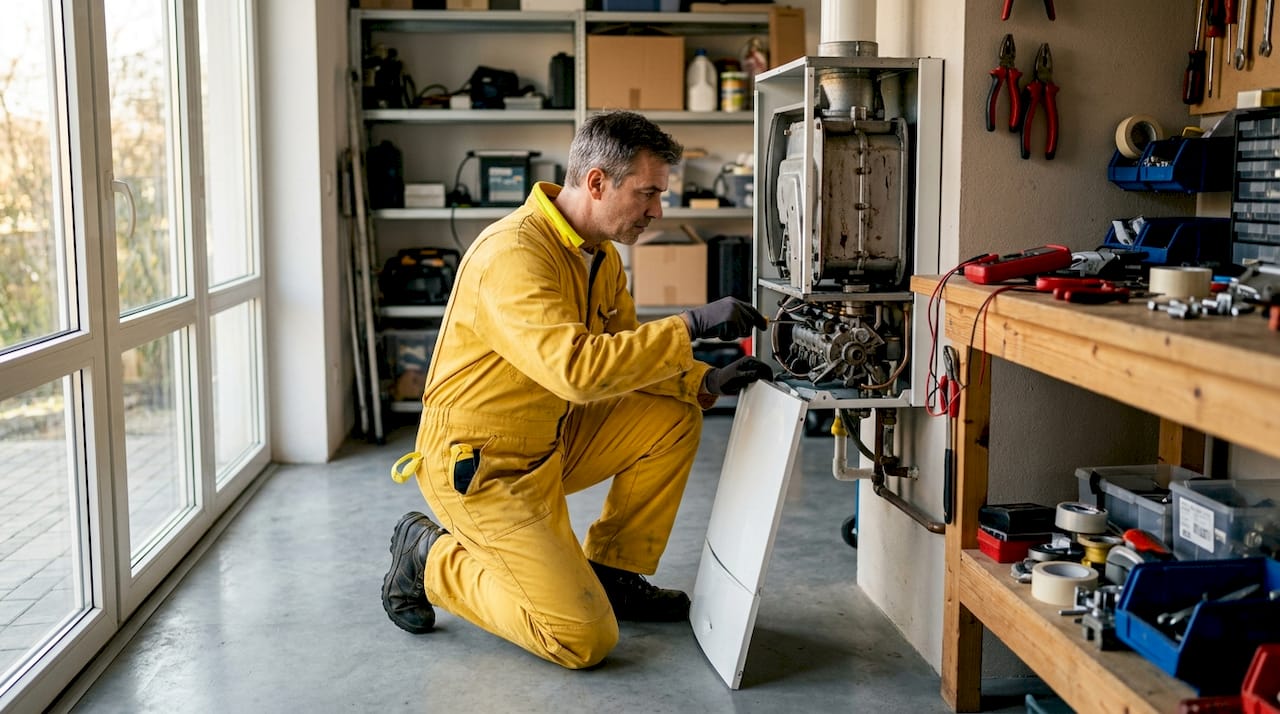
Once the casing comes off, the engineer inspects the burner, injectors, heat exchanger, and seals. A thorough service includes disassembly and close inspection of every component that touches combustion. Scaling on the heat exchanger, corrosion on the burner, or worn seals are early warning signs. Catching them now costs far less than replacing a cracked heat exchanger in december.
3. Flue gas analysis and combustion testing
This is the most technically critical step. The engineer inserts a probe into the flue and measures the gases produced during combustion. Flue gas analysis detects incomplete combustion and hidden risks before any part actually fails. A properly serviced condensing boiler should hit 89–94% efficiency on this test. If the CO/CO2 ratio exceeds 0.004, the engineer must investigate further before leaving.
4. Cleaning and condensate trap flushing
The burner gets cleaned of carbon deposits. The condensate trap, which collects acidic water produced during condensing operation, gets flushed to prevent blockages. A blocked condensate trap is one of the most common reasons boilers lock out in winter. This step takes only a few minutes but prevents a service call on the coldest night of the year.
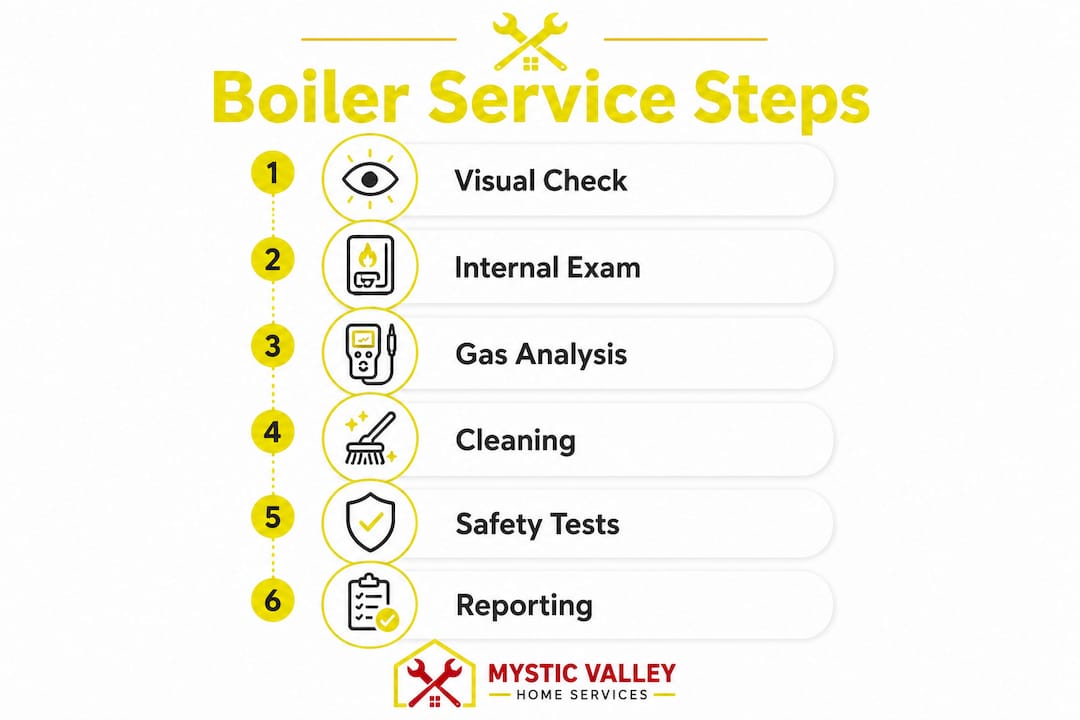
5. Pressure checks and safety control testing
The engineer checks system pressure and tests every safety control, including the pressure relief valve and thermostat response. These tests confirm the boiler will shut itself down correctly if something goes wrong. A boiler that fails to shut off under fault conditions is a serious hazard.
6. Documentation and benchmarking
The engineer records all readings, findings, and the date of service in a service report. This document is your proof of compliance for warranty and insurance purposes. Keep it with your home records.
Pro Tip: Ask the engineer to walk you through the flue gas analysis readings before they leave. Understanding your boiler’s efficiency score gives you a baseline to compare against next year.
Why is annual boiler servicing important for safety and efficiency?
The importance of boiler servicing goes well beyond ticking a box. Three distinct areas make it worth scheduling every year without fail.
Safety: carbon monoxide is invisible
Carbon monoxide has no color and no smell. A boiler with a cracked heat exchanger or a partially blocked flue can leak CO into your home without any visible sign. Annual servicing catches these faults before they become dangerous. The CO/CO2 ratio test is the primary tool for detecting this risk early.
Efficiency and energy costs
Annual preventive maintenance can reduce energy consumption by 10–20% and extend a boiler’s operational lifespan by up to 15 years. That is a significant return on a single annual appointment. A boiler running with a dirty burner or scaled heat exchanger works harder to produce the same heat, which shows up directly on your gas bill.
Warranty and insurance compliance
- Manufacturers require documented annual servicing to keep the warranty valid. A single missed service can void coverage entirely.
- Many home insurance policies require proof of annual professional service to pay out on heating-related claims.
- The service report is your legal evidence. Without it, both warranty and insurance claims become difficult to defend.
- A boiler service focuses on early warning signs like scaling, corrosion, and seal problems. It is not a repair visit.
- Repairs identified during a service require a separate appointment and separate charges. Do not confuse the two.
“Annual servicing is not maintenance for its own sake. It is risk management. The cost of one service is a fraction of the cost of a boiler replacement, a carbon monoxide incident, or a voided warranty claim.”
For a broader view of home system upkeep, the home plumbing maintenance checklist from Mysticvalleyservices puts boiler care in context alongside your full plumbing system.
How often should you schedule a boiler service?
The industry recommendation is clear: once per year, every year. The timing of that appointment matters almost as much as the frequency.
- Schedule in late spring or early summer. The best time to book is after the heating season, typically may through july. Engineers are less busy, appointment slots are easier to get, and any faults found can be repaired before the next heating season starts.
- Avoid booking in october or november. Demand spikes when temperatures drop. You may wait weeks for an appointment, and a fault found then may not get repaired before you need heat.
- Landlords face legal obligations. In Massachusetts, landlords must maintain heating systems in safe working order. Annual servicing is the clearest way to document compliance.
- Homeowners have no legal mandate but do have a warranty obligation. Skipping a service to save money often costs more when the warranty claim gets denied.
- Always use a Gas Safe registered engineer. In the United States, look for engineers certified under relevant state licensing requirements. Unqualified technicians may miss critical safety checks or perform work that voids your warranty.
- Never skip two years in a row. A single missed service is recoverable. Two consecutive missed services allow wear to compound, and the next service often turns into a repair bill.
For homeowners considering a preventive maintenance contract, bundling annual boiler service into a broader plan removes the scheduling burden entirely.
What should you expect after the boiler service?
The appointment ends, but the process is not finished. What happens next determines whether you actually get the full value of the service.
Reading your service report
The engineer leaves a written service report. This document records every reading taken, every component inspected, and any findings noted. Review it before the engineer leaves. If a reading is outside normal range, ask what it means and what the recommended next step is.
- Benchmark your efficiency score. A condensing boiler hitting 89–94% efficiency is performing well. A score below that range warrants a follow-up conversation.
- Note any advisory items. These are not urgent faults but components showing early wear. They are the engineer’s way of flagging what to watch before next year’s service.
- Distinguish findings from repairs. If the engineer identifies a faulty part, that is a separate job. Annual service is not an immediate repair visit. Get a written quote for any repair work before agreeing to it.
- Store the report safely. Your warranty provider and insurer may ask for it. A digital photo of the report stored in your email is a reliable backup.
- Ask about the next service date. Some engineers will note the recommended return date on the report. Put it in your calendar the same day.
Pro Tip: If the engineer finds an advisory item, ask them to estimate how long that component typically lasts before it needs replacing. That gives you a planning window, not a surprise.
Understanding the inspection phases in detail helps you ask better questions when the engineer walks you through their findings.
Key Takeaways
Annual boiler servicing is the single most effective action a homeowner can take to prevent carbon monoxide risk, protect warranty coverage, and reduce heating costs over the long term.
| Point | Details |
|---|---|
| Service duration | A standard annual boiler service takes 45–90 minutes from inspection to documentation. |
| Combustion safety test | Flue gas analysis must confirm a CO/CO2 ratio below 0.004 to pass the safety check. |
| Efficiency and lifespan | Annual maintenance can cut energy use by 10–20% and extend boiler life by up to 15 years. |
| Warranty compliance | Manufacturers and insurers require documented annual service to honor coverage claims. |
| Best scheduling window | Book in late spring or early summer to avoid peak demand and fix faults before winter. |
Why I think most homeowners underestimate what a boiler service actually is
After seeing dozens of boiler service appointments, the pattern I notice most is this: homeowners treat the annual service like an oil change. They want it done fast, they want a sticker on the unit, and they want to move on. That mindset costs them.
The flue gas analysis alone tells a story most homeowners never hear because they are not in the room when the engineer takes the reading. A boiler running at 82% efficiency when it should be at 91% is burning extra gas every single day. Over a full heating season, that gap adds up to real money. The service is the only moment you get that data.
The other thing I see consistently is confusion between a service and a repair call. Homeowners call for a service expecting the engineer to fix the noise the boiler has been making for three months. That is not how it works. The service identifies the problem. The repair is a separate visit. Knowing this in advance prevents frustration and helps you budget correctly.
My honest advice: stay in the room during the service. Ask the engineer to narrate what they are doing. Ask what the flue gas reading means. Ask what the advisory items are. A good engineer will welcome the questions. The ones who rush you out of the room are the ones to be cautious about.
Selecting a qualified, experienced engineer matters more than the price of the service. The cheapest appointment is rarely the most thorough one.
— Matt
Mysticvalleyservices annual boiler service for Massachusetts homeowners
Mysticvalleyservices provides professional annual boiler servicing for homeowners across Massachusetts. Every service includes a full visual inspection, internal component examination, flue gas analysis, combustion efficiency testing, and a written service report you can use for warranty and insurance documentation.
The Mysticvalleyservices team works to the same safety standards required by boiler manufacturers, so your warranty stays intact and your home stays safe. Service plans are available for homeowners who want to lock in annual appointments without the hassle of rebooking each year. Schedule your annual boiler service with Mysticvalleyservices and get a clear, documented picture of your heating system’s health before the next heating season starts.
FAQ
What does an annual boiler service include?
A standard annual boiler service includes a visual inspection, internal component check, flue gas analysis, burner cleaning, condensate trap flushing, pressure testing, and a written service report. The full appointment takes 45–90 minutes depending on the boiler model.
Do I need a boiler service every year?
Manufacturers require annual servicing to keep the warranty valid, and most home insurance policies require documented proof of professional service. There is no legal mandate for homeowners, but skipping a service risks voiding both warranty and insurance coverage.
How does flue gas analysis work during a boiler service?
The engineer inserts a probe into the flue to measure combustion gases, specifically the CO/CO2 ratio. A reading above 0.004 indicates incomplete combustion and requires further investigation before the boiler is cleared as safe.
What is the best time of year to book a boiler service?
Late spring or early summer is the best window. Engineers are less in demand, appointments are easier to schedule, and any faults found can be repaired well before the heating season begins.
Is a boiler service the same as a boiler repair?
No. A boiler service is a preventative inspection focused on identifying early wear and confirming safe operation. If a fault is found, repairs require a separate visit and a separate charge.