Common restaurant plumbing mistakes are preventable errors in design, maintenance, and operation that trigger health code violations, forced closures, and repair bills that dwarf the cost of prevention. Restaurant plumbing operates under far greater stress than residential systems. High-volume dishwashers, commercial fryers, and prep sinks push grease, food particles, and hot water through pipes at a pace that exposes every weak point in the system. Operators who treat plumbing as a background concern rather than a core operational system pay for that assumption in emergency service calls and lost revenue.
1. Undersizing or neglecting the grease trap
Grease trap neglect is the costliest single operational error in restaurant plumbing. A grease trap intercepts fats, oils, and grease (FOG) before they enter the municipal sewer line. When the trap is undersized for the kitchen’s output, FOG bypasses the trap entirely and coats downstream pipes, building blockages that worsen with every service.
A grease trap reaching 25% of liquid volume capacity is effectively full and at risk of bypass before any smell becomes noticeable. That means operators relying on odor as a warning sign are already too late. Monthly borescope inspections give you a real picture of capacity before a bypass occurs.
The financial gap between routine and emergency service is significant. Routine cleaning costs a fraction of what an emergency sewer backup cleanup demands, plus you absorb lost revenue during the shutdown. Scheduling pumping every one to three months, depending on kitchen volume, keeps that gap firmly in your favor.
- Confirm your trap is sized for your kitchen’s peak FOG output, not just its square footage
- Schedule pumping on a fixed calendar, not when odors appear
- Keep a cleaning log with dates and volumes removed for health inspection records
Pro Tip: Ask your plumber to perform a borescope inspection monthly rather than estimating capacity by smell or schedule alone. Visual confirmation is the only reliable method.
Properly sized grease interceptor installation requires professional design before kitchen build-out. Retrofitting an undersized trap after construction costs far more than getting the specification right the first time.
2. Missing or misplaced floor drains
Floor drains placed too far from high-output equipment create standing water, sanitation failures, and slip hazards. Every dishwasher station, prep sink, and cooking line needs a drain within the splash zone. When drains are absent or poorly positioned, water pools on the floor and carries grease and food debris toward walls and equipment bases.
Poor floor slope compounds the problem. A commercial kitchen floor needs a consistent pitch toward each drain. Without it, water stagnates and bacteria multiply. Many older kitchens were built with residential-grade slopes that simply cannot handle commercial water volume.
- Position floor drains directly under or adjacent to dishwashers, ice machines, and prep sinks
- Verify floor pitch during any remodel or new build, not after tile is set
- Install cleanouts at accessible points along drain lines so blockages can be cleared without demolition
Grease buildup is the primary cause of sewer line blockages in restaurants. Food particles bond to grease coating the pipe walls, narrowing the flow path over time until a full blockage occurs.
Chemical drain cleaners do not fix grease buildup in commercial lines. They dissolve surface material temporarily but leave the underlying coating intact. Hydro-jetting is the most effective solution for removing hardened FOG from commercial drain lines. The high-pressure water cuts through grease accumulation that a residential snake cannot reach.
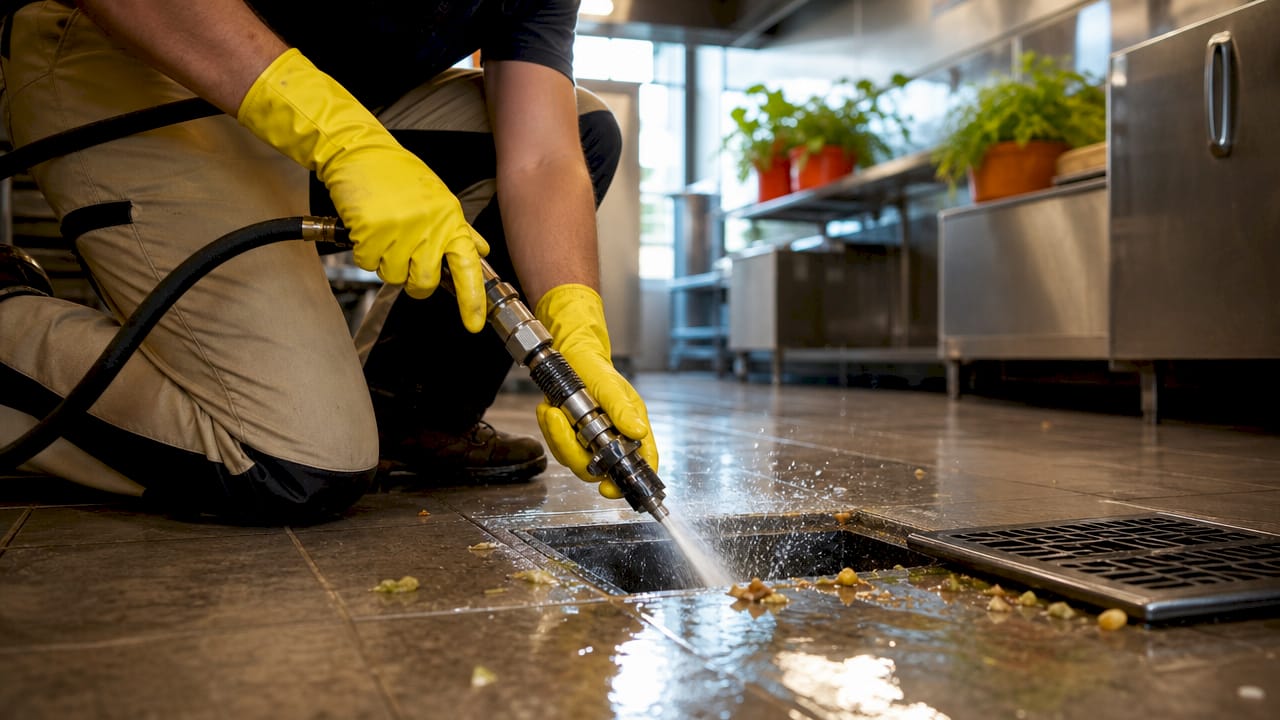
Pro Tip: Schedule hydro-jetting for your main kitchen drain lines every six months, regardless of whether drains appear slow. Waiting for a backup means paying emergency rates and losing a service period.
3. Inadequate water supply pressure and hot water failures
High-demand commercial kitchens require water heaters sized for simultaneous peak loads, not average daily use. When a commercial dishwasher, a three-compartment sink, and multiple hand sinks all draw hot water at once, an undersized water heater fails to maintain temperature. That failure has direct health code consequences.
Missing hot water at hand sinks is a top priority violation for health inspectors and can result in immediate closure. Hand-washing stations must deliver hot water at the required temperature at all times during service. A water heater that cannot keep pace with peak demand puts your operating license at risk.
Backflow prevention is equally critical. Beverage lines, ice machines, and dishwashers all connect to the potable water supply. Without properly installed backflow preventers, contaminated water can siphon back into the supply line. Health inspectors flag missing or non-functional backflow devices as immediate violations.
- Size your water heater for simultaneous peak demand across all fixtures, not average use
- Install backflow preventers on every connection between equipment and the potable supply
- Test backflow preventers annually and keep the test records on file for inspections
- Verify water pressure at the main supply line meets the minimum required for commercial dishwasher operation
Improper venting creates a separate but related problem. Drain vents equalize air pressure in the drain lines. Without correct venting, drains run slowly, gurgle, and allow sewer gas to enter the kitchen. Sewer gas contains hydrogen sulfide, which is both a health hazard and a sign of systemic venting failure.
4. Applying residential plumbing logic to commercial systems
Using residential plumbing logic in commercial kitchens causes repeated failures and severe damage. Residential pipe sizing, fixture ratings, and drain configurations are built for household loads. A commercial kitchen runs at multiples of that load for twelve or more hours a day.
Pipe sizing is a clear example. A residential kitchen drain may be sized at 1.5 inches. A commercial dishwasher drain requires 2 inches or larger to handle the volume and temperature of discharge water. Undersized pipes back up under load and cause water damage to floors and substructure.
Plumbing is a health code priority, not just a maintenance concern. Health inspectors evaluate plumbing compliance as a core part of every inspection, and violations in this category carry the highest closure risk. An operator who hired a residential plumber to save money on a commercial installation may face a closure order on the first inspection.
- Never hire a plumber without verified commercial kitchen experience for restaurant work
- Confirm that all fixture installations meet local commercial plumbing codes, not just residential standards
- Require permits and inspections for all new plumbing work so violations are caught before service begins
Pro Tip: Ask any plumber you hire to name the last three commercial kitchen projects they completed. If they cannot, keep looking. Restaurant plumbing requires specific knowledge of grease management, high-temperature systems, and health code requirements.
Understanding why pipe sizing matters in commercial buildings helps operators ask the right questions before any installation begins.
5. Ignoring early warning signs
Slow drains, gurgling noises, and odors indicate systemic plumbing issues that operators routinely dismiss until a full backup forces action. Waiting for a complete blockage means paying emergency service rates, absorbing the cost of water damage cleanup, and losing revenue during the repair window.
A gurgling drain is not a minor inconvenience. It signals that air is being pulled through a partial blockage or that venting is compromised. Either condition worsens without intervention. A foul odor from a floor drain during service points to a dry trap, a venting failure, or grease accumulation in the line.
Video pipe inspections are the most reliable diagnostic tool for identifying whether a slow drain is caused by grease buildup or a structural issue like a pipe offset or partial collapse. Treating a structural problem with hydro-jetting alone can worsen the damage. A camera inspection first tells you exactly what you are dealing with.
Ignoring early signs leads to more costly emergency responses and business interruptions. The cost difference between a scheduled service call and an emergency response is substantial, and the operational disruption of an emergency is far harder to manage during a busy service period.
6. Skipping preventive maintenance and record-keeping
Preventive maintenance is the single most effective way to avoid plumbing failures in a restaurant. Operators who schedule grease trap pumping, line jetting, and backflow testing on a fixed calendar rarely face emergency shutdowns. Those who wait for problems to appear pay emergency rates and absorb the operational cost of unplanned downtime.
Record-keeping is equally important and frequently overlooked. Health inspectors expect to see documentation of grease trap cleanings, backflow preventer tests, and plumbing repairs. Missing records create the impression of neglect, even when maintenance has been performed. A simple log with dates, service providers, and work completed satisfies this requirement.
Older buildings with galvanized steel supply lines, cast iron drains, and clay sewer laterals face accelerated failure risks. These materials are at or beyond their service life in many commercial buildings. Cast iron and clay pipes retain rough interiors that accelerate grease adhesion and sludge accumulation, requiring more frequent cleaning and inspection than modern PVC or ABS systems.
A commercial plumbing inspection performed annually gives operators a clear picture of pipe condition, trap performance, and any code compliance gaps before a health inspector finds them first.
| Maintenance Task | Recommended Frequency |
|---|---|
| Grease trap pumping | Every 1–3 months based on volume |
| Main drain line hydro-jetting | Every 6 months |
| Backflow preventer testing | Annually |
| Video pipe inspection | Annually or after any major blockage |
| Plumbing compliance review | Before each health inspection |
Key takeaways
The most effective way to avoid costly restaurant plumbing failures is to treat grease management, preventive maintenance, and commercial-grade installation as non-negotiable operational standards.
| Point | Details |
|---|---|
| Grease trap sizing is critical | Size the trap for peak FOG output and pump every 1–3 months to prevent bypass. |
| Hydro-jetting beats chemicals | Use hydro-jetting every six months to clear hardened grease that chemical cleaners cannot remove. |
| Hot water and backflow are inspection priorities | Missing hot water or backflow preventers triggers immediate closure violations. |
| Residential plumbing fails in commercial kitchens | Always hire plumbers with verified commercial kitchen experience and pull permits for all work. |
| Early warning signs demand action | Gurgling drains and odors signal systemic issues. Schedule a video inspection before a full backup occurs. |
What I’ve learned from restaurant plumbing calls in the field
The pattern I see most often is operators who know something is wrong but wait. A drain runs slow for two weeks. A faint odor shows up during the dinner rush. The grease trap hasn’t been pumped in six months. None of it gets addressed until a backup floods the kitchen floor at 6:30 PM on a Friday.
The operators who avoid that scenario are not the ones with newer buildings or better equipment. They are the ones who treat plumbing as a scheduled operational task, the same way they schedule hood cleaning or equipment calibration. They keep logs. They call before something fails.
The other mistake I see consistently is hiring the wrong contractor. A plumber who handles residential work competently may have no experience with grease interceptor sizing, commercial venting requirements, or the specific health code standards that apply to food service operations. That gap shows up fast, either on the first health inspection or the first high-volume service night.
Choosing a contractor with documented commercial kitchen experience, pulling permits for every installation, and maintaining a preventive plumbing contract are the three decisions that separate operators who manage their plumbing from those who react to it.
— Matt
Mysticvalleyservices: commercial plumbing support for Massachusetts restaurants
Restaurant plumbing problems do not follow a convenient schedule. Mysticvalleyservices provides commercial plumbing services across Massachusetts, including routine grease trap maintenance, hydro-jetting, backflow preventer testing, and video pipe inspections. The team works with restaurant operators to build maintenance schedules that keep kitchens compliant and running without interruption.
For operators who want to stop reacting and start preventing, Mysticvalleyservices offers commercial plumbing services designed specifically for food service environments. Emergency response is available when the unexpected happens, and preventive contracts keep those calls rare. Contact Mysticvalleyservices to schedule a plumbing health check and build a maintenance plan that fits your kitchen’s volume and inspection calendar. You can also review emergency plumbing contract options to protect your operation against unplanned downtime.
FAQ
What is the most common restaurant plumbing mistake?
Neglecting grease trap maintenance is the most common and costly restaurant plumbing error. A trap that reaches 25% of its liquid volume capacity is effectively full and will bypass FOG into the sewer line before any odor appears.
How often should a restaurant grease trap be cleaned?
Most commercial kitchens require grease trap pumping every one to three months, depending on cooking volume and FOG output. Cleaning logs should be kept on file for health inspection review.
Can a restaurant be closed for plumbing violations?
Yes. Missing backflow prevention devices and the absence of hot water at hand sinks are top-priority health code violations that can result in immediate closure orders.
What is hydro-jetting and why do restaurants need it?
Hydro-jetting uses high-pressure water to cut through hardened grease and food debris inside drain lines. It is the most effective method for clearing FOG buildup that chemical cleaners and residential snaking cannot remove.
How do I know if my restaurant has a plumbing problem before it becomes an emergency?
Slow drains, gurgling sounds, and foul odors during service are early indicators of systemic plumbing issues. A video pipe inspection identifies whether the cause is grease buildup or a structural pipe problem before a full backup occurs.